All Resources

Social and Nature Prescribing: Considerations for Health and Environment
This playbook offers practical guidance and considerations for integrating social and nature prescribing into healthcare practices, fostering community partnerships, promoting high-impact programs, and better understanding the potential for environmental co-benefits of these programs. It is intended for health care providers, program administrators, link workers, researchers, educators, and anyone else interested in better understanding the environmental co-benefits of social and nature prescribing. Developed in collaboration with the Canadian Institute for Social Prescribing (CISP), a national hub anchored by the Canadian Red Cross, this playbook builds on a literature review and expert guidance to connect healthcare, social services, and community supports for improved health and well-being. The playbook aims to: Provide background information, resources, and considerations for guiding social and nature prescribing practices. Highlight how nature prescribing, as a variation of social prescribing, can generate significant environmental co-benefits.
Playbook

Sustainable Occupational Therapy
This Playbook is intended to do the following: a) Provide background information, resources, and considerations to guide more sustainable and climate-resilient occupational therapy. b) Highlight the contributions that occupational therapy can make in transitioning current healthcare systems towards high-quality, low-carbon, sustainable and climate-resilient care.
Playbook

Case-Based Module: Planetary Health for Family Medicine Residents and Teachers – Applying a planetary health lens to clinical encounters
Temerty Faculty of Medicine, DFCM, University of Toronto
Course

Planetary Health for Family Medicine Residents and Teachers
Temerty Faculty of Medicine, DFCM, University of Toronto
Course

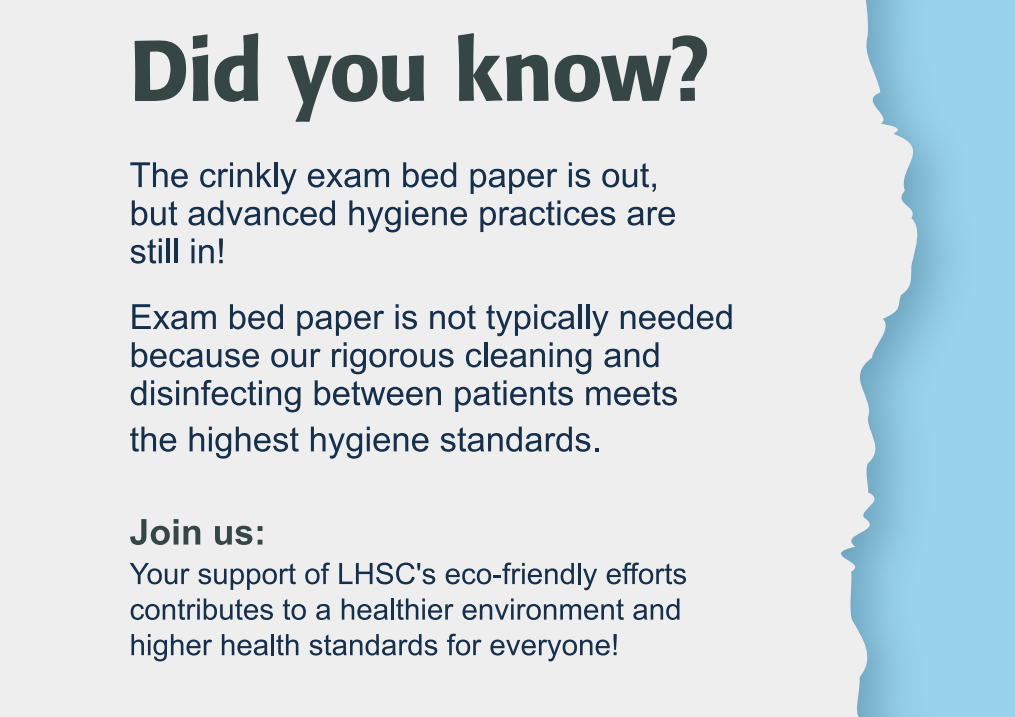
Exam Room Wall Poster
London Health Sciences Centre

An example of an exam room poster provided by London Health Sciences Centre on how exam bed paper does not reduce the spread of infections.
Poster

Go Green, Cut the Paper: Eliminating Exam Table Paper
London Health Sciences Centre
A one-page summary explaining why exam table paper should be eliminated.
Document

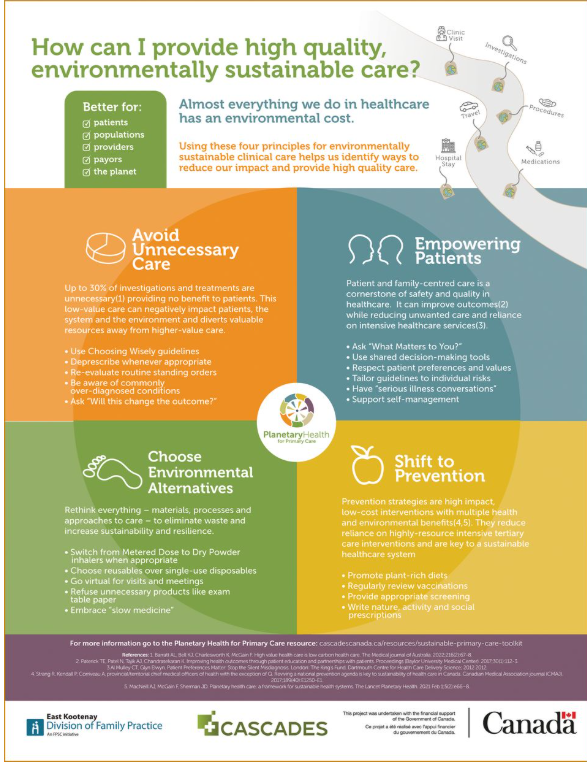
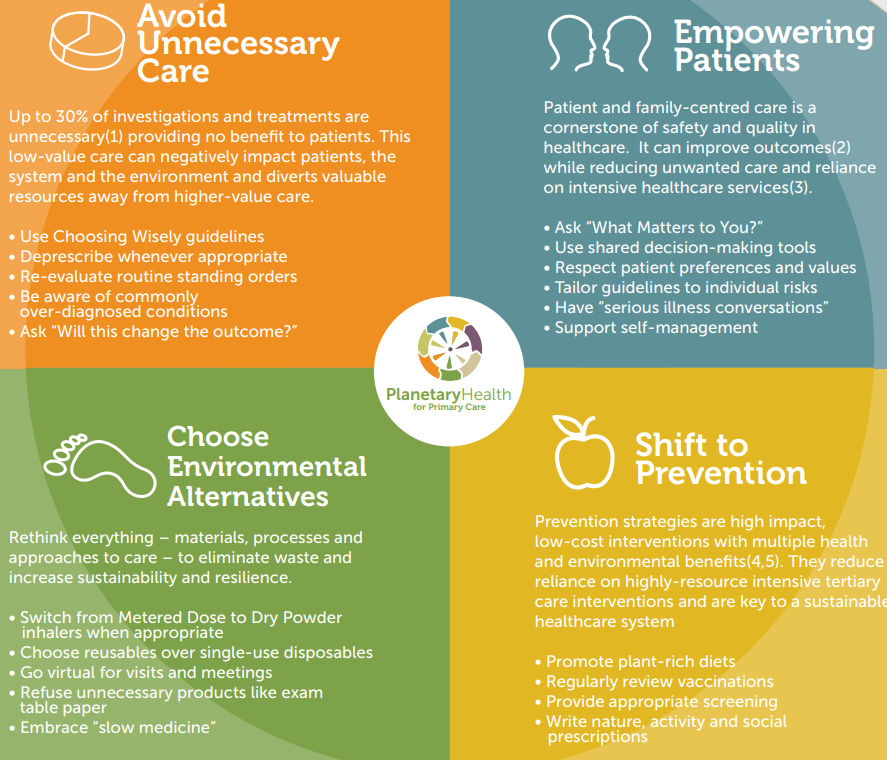
Four Principles of Environmentally Sustainable Clinical Care
CASCADES
An infographic for planetary health in primary care featuring four principles for environmentally sustainable healthcare: avoid unncessary care, empowering patients, choose environmental alternatives, shift to prevention.
Infographic

Planetary Health for Primary Care
This primer is an introduction to planetary health in the primary care setting and is designed to highlight ways practitioners can integrate these principles into their clinical work. It is not intended to duplicate existing resources on other important topics such as political and personal actions or hospital-based solutions. It oers examples, practice tips and links to existing resources to educate, inspire and remove barriers to change, organized around the our principles. Readers may want to read it from start to finish or by sections.
Tool

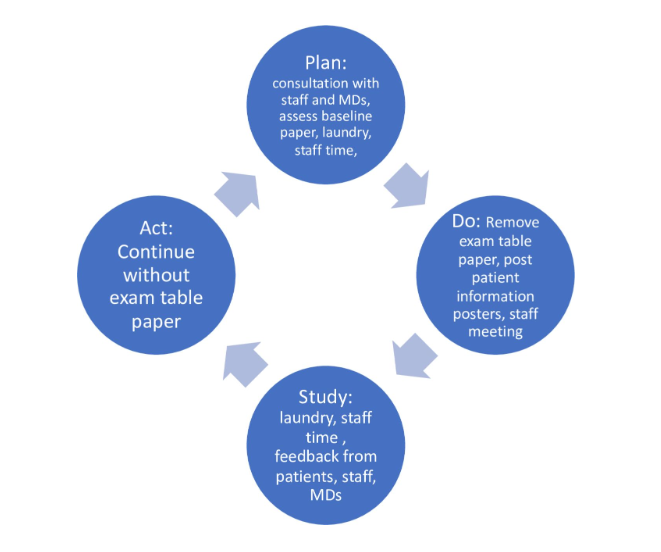
Reducing healthcare waste by eliminating exam table paper in a primary care practice: a sustainable quality improvement initiative
This simple QI project demonstrates the feasibility of implementing a small change in a primary care clinic that can improve environmental sustainability with multiple co-benefits. If all family physicians in Canada eliminated exam table paper in their offices, it would result in savings of approximately 95 940 km of paper, 121 680 trees, $C8 400 600 and 3054 T CO2 emissions, equivalent to driving around the world 360 times.
Article

Planetary health lens for primary care: Considering environmental sustainability offers benefits to patients and to providers
Adopting a planetary health lens provides a new way to think about environmental sustainability in primary care. With many providers working together to incorporate the 4 principles of sustainable health care into our everyday work, we can help reduce the health sector’s environmental footprint with additional benefits for patients, providers, and the health care system.
Article