All Resources

Social and Nature Prescribing: Considerations for Health and Environment
This playbook offers practical guidance and considerations for integrating social and nature prescribing into healthcare practices, fostering community partnerships, promoting high-impact programs, and better understanding the potential for environmental co-benefits of these programs. It is intended for health care providers, program administrators, link workers, researchers, educators, and anyone else interested in better understanding the environmental co-benefits of social and nature prescribing. Developed in collaboration with the Canadian Institute for Social Prescribing (CISP), a national hub anchored by the Canadian Red Cross, this playbook builds on a literature review and expert guidance to connect healthcare, social services, and community supports for improved health and well-being. The playbook aims to: Provide background information, resources, and considerations for guiding social and nature prescribing practices. Highlight how nature prescribing, as a variation of social prescribing, can generate significant environmental co-benefits.
Playbook

Sustainable Occupational Therapy
This Playbook is intended to do the following: a) Provide background information, resources, and considerations to guide more sustainable and climate-resilient occupational therapy. b) Highlight the contributions that occupational therapy can make in transitioning current healthcare systems towards high-quality, low-carbon, sustainable and climate-resilient care.
Playbook

Case-Based Module: Planetary Health for Family Medicine Residents and Teachers – Applying a planetary health lens to clinical encounters
Temerty Faculty of Medicine, DFCM, University of Toronto
Course

Planetary Health for Family Medicine Residents and Teachers
Temerty Faculty of Medicine, DFCM, University of Toronto
Course

Opportunities to address the environmental impacts of medication in primary care
This webinar examines how medications, while essential to healthcare, have significant environmental impacts and can contribute substantially to healthcare’s carbon footprint, particularly in primary care. It explains that most prescriptions are written in primary care, creating an opportunity for more sustainable prescribing practices that combine patient-centred care with reduced environmental impact. The session in the Sustainable Primary & Community Care Implementation Series features Ilona Hale, a family physician with the East Kootenay Division of Family Practice and Assistant Clinical Professor at the University of British Columbia, and Trudy Huyghebaert, a clinical pharmacist with the University of Calgary and Alberta Health Services, who share prescriber and pharmacist perspectives on sustainable medication use.
Webinar

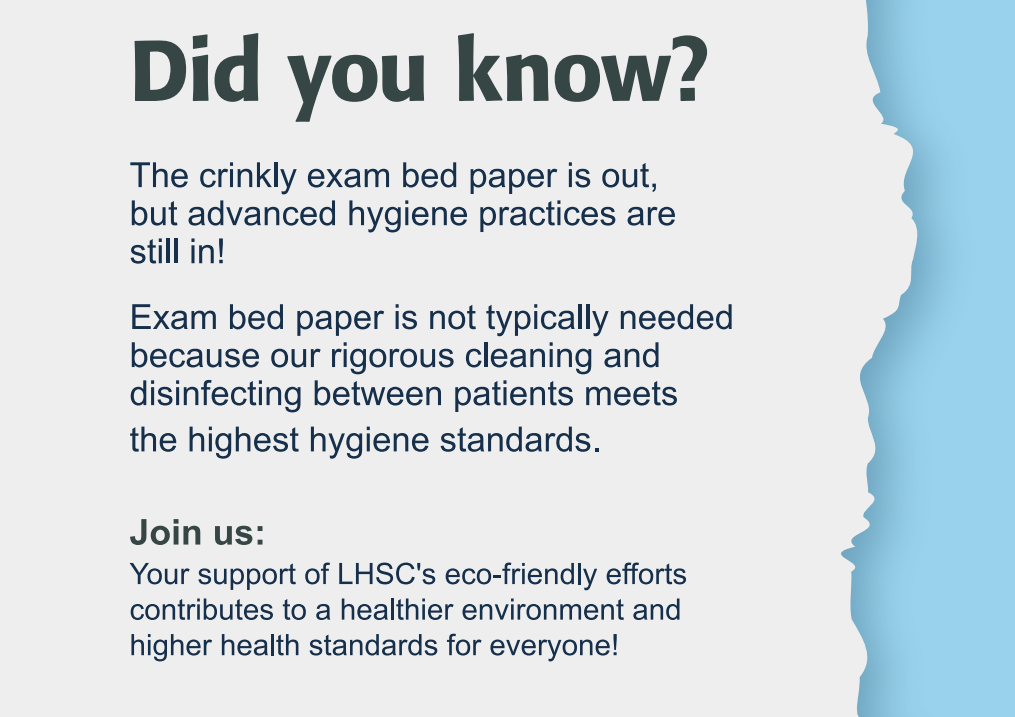
Exam Room Wall Poster
London Health Sciences Centre
An example of an exam room poster provided by London Health Sciences Centre on how exam bed paper does not reduce the spread of infections.
Poster

Leveraging Sustainable Occupational Therapy for climate mitigation and adaptation
This webinar explores how occupational therapy can support climate-conscious, sustainable healthcare. It highlights ways practitioners can reduce environmental impacts, design nature-informed services, and build climate resilience. Janet Craik and Nancy Rushford present the Sustainable Occupational Therapy playbook, offering guidance for low-carbon, sustainable occupational therapy practice.
Webinar

Go Green, Cut the Paper: Eliminating Exam Table Paper
London Health Sciences Centre
A one-page summary explaining why exam table paper should be eliminated.
Document

Four Principles of Environmentally Sustainable Clinical Care
CASCADES
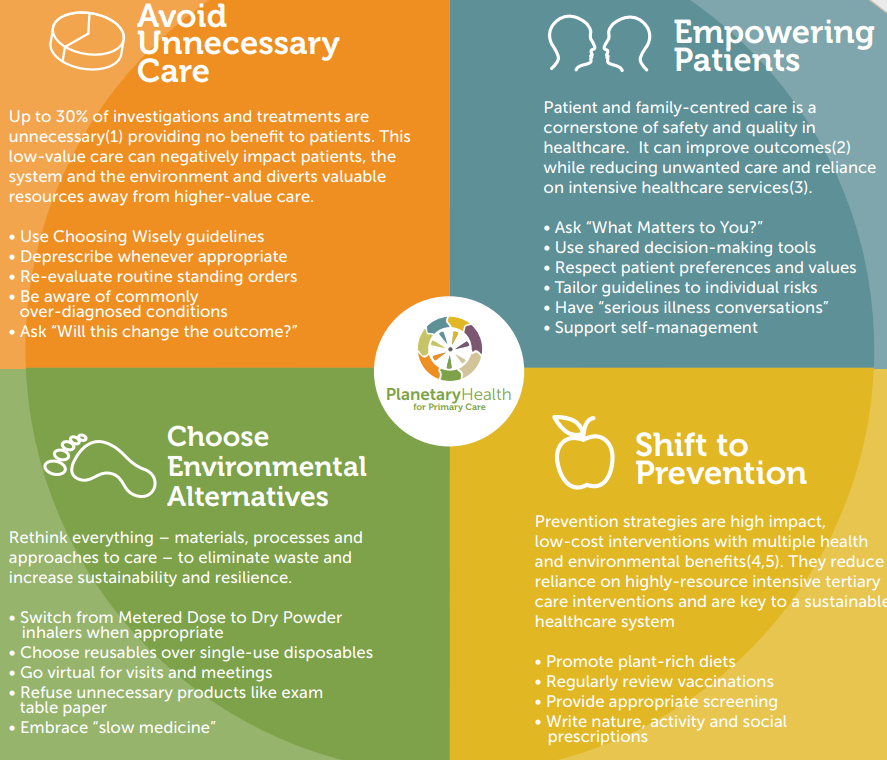
An infographic for planetary health in primary care featuring four principles for environmentally sustainable healthcare: avoid unncessary care, empowering patients, choose environmental alternatives, shift to prevention.
Infographic

Planetary Health for Primary Care
This primer is an introduction to planetary health in the primary care setting and is designed to highlight ways practitioners can integrate these principles into their clinical work. It is not intended to duplicate existing resources on other important topics such as political and personal actions or hospital-based solutions. It oers examples, practice tips and links to existing resources to educate, inspire and remove barriers to change, organized around the our principles. Readers may want to read it from start to finish or by sections.
Tool