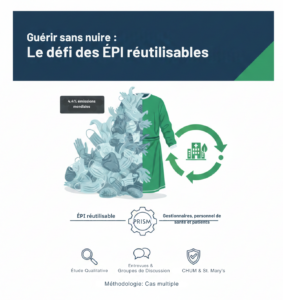
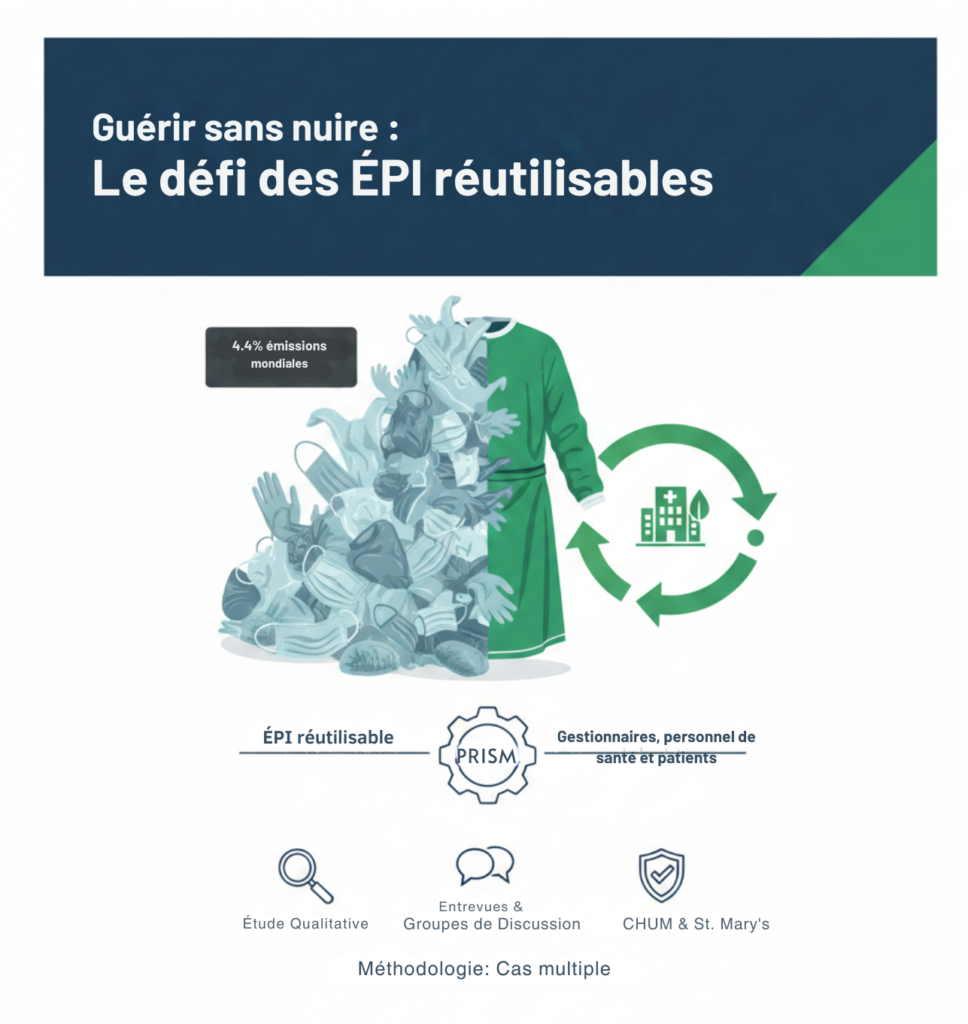
Climate change and pollution are major public health challenges. The health care sector generates approximately 4.4% of global greenhouse gas emissions. Reusable personal protective equipment (PPE-R) could reduce its environmental footprint, but its adoption raises economic, logistical, and safety concerns.
This study examines the factors associated with the adoption and implementation of PPE-R in Quebec. It has three objectives:
(1) to analyze managers’ perspectives on governance, logistics, and change management
(2) to explore health care professionals’ and patients’ perspectives on safety, comfort, and acceptability
(3) to examine external participants perspectives—including regulatory bodies, professional associations, and sector stakeholders—on procurement and the market.
A qualitative multiple-case study was conducted involving 43 participants from two Quebec health care institutions, comprising 39 individual interviews and two focus groups. The conceptual framework was based on the Practical, Robust Implementation and Sustainability Model (PRISM). The adoption and implementation of PPE-R constitutes a complex organizational process shaped by clinical, organizational, external, and systemic factors. For example, perceived safety and comfort influence adoption, whereas leadership and logistics determine implementation.
This research contributes to the still-limited literature on PPE-R by extending the analysis beyond safety and life cycle considerations to the conditions required for sustainable implementation. It also provides a clearer understanding of the external environment, including public policies, procurement, and regulation. These findings enable managers’ planning for PPE-R implementation.
Master’s thesis by Luis Enrique Moreno Exebio, School of Public Health, Université de Montréal, under the supervision of Professor Nathalie Clavel.
If you have any questions about the thesis, please contact the author at luis.enrique.moreno.exebio@umontreal.ca
If you have any questions about the EPI-R guide and the Éco-Innov project, please contact jonathan.bichon.chum@ssss.gouv.qc.ca