All Resources

Social and Nature Prescribing: Considerations for Health and Environment
This playbook offers practical guidance and considerations for integrating social and nature prescribing into healthcare practices, fostering community partnerships, promoting high-impact programs, and better understanding the potential for environmental co-benefits of these programs. It is intended for health care providers, program administrators, link workers, researchers, educators, and anyone else interested in better understanding the environmental co-benefits of social and nature prescribing. Developed in collaboration with the Canadian Institute for Social Prescribing (CISP), a national hub anchored by the Canadian Red Cross, this playbook builds on a literature review and expert guidance to connect healthcare, social services, and community supports for improved health and well-being. The playbook aims to: Provide background information, resources, and considerations for guiding social and nature prescribing practices. Highlight how nature prescribing, as a variation of social prescribing, can generate significant environmental co-benefits.
Playbook

Sustainable Occupational Therapy
This Playbook is intended to do the following: a) Provide background information, resources, and considerations to guide more sustainable and climate-resilient occupational therapy. b) Highlight the contributions that occupational therapy can make in transitioning current healthcare systems towards high-quality, low-carbon, sustainable and climate-resilient care.
Playbook

Case-Based Module: Planetary Health for Family Medicine Residents and Teachers – Applying a planetary health lens to clinical encounters
Temerty Faculty of Medicine, DFCM, University of Toronto
Course

Planetary Health for Family Medicine Residents and Teachers
Temerty Faculty of Medicine, DFCM, University of Toronto
Course

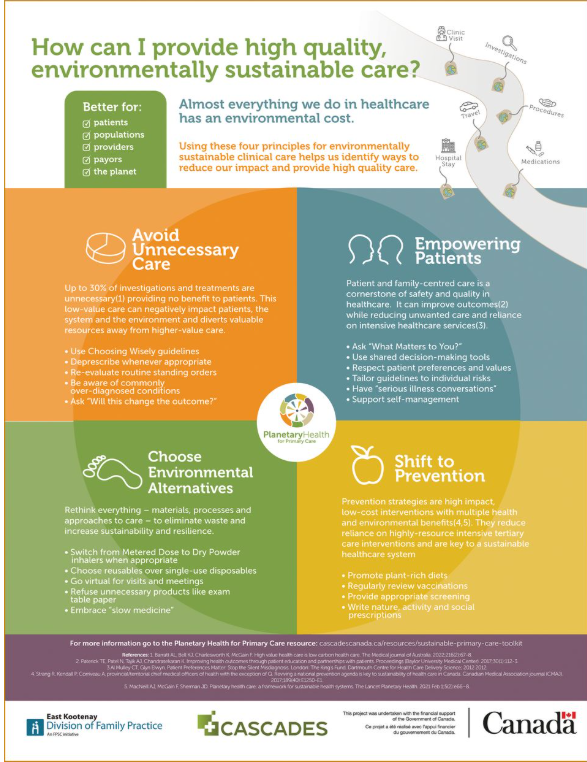
Planetary health lens for primary care: Considering environmental sustainability offers benefits to patients and to providers
Adopting a planetary health lens provides a new way to think about environmental sustainability in primary care. With many providers working together to incorporate the 4 principles of sustainable health care into our everyday work, we can help reduce the health sector’s environmental footprint with additional benefits for patients, providers, and the health care system.
Article

Reducing our Environmental Impact in Primary Care
This webinar features Ilona Hale, MD, exploring new ideas in environmentally sustainable clinical practice. It goes beyond basic measures like recycling and energy-efficient lighting, highlighting the connection between environmental sustainability and high-quality care, including patient-centred care, de-prescribing, and health promotion. The session explains how practicing high-quality, low-carbon care can improve patient outcomes, reduce healthcare system burden, decrease provider workload, and help address climate change. Ilona Hale is a family physician with the East Kootenay Division of Family Practice and an Assistant Clinical Professor in the Department of Family Practice at the University of British Columbia.
Webinar

Pathway to Climate Resilience in Primary Health Care
This webinar presents a fireside chat hosted by CASCADES, the Indigenous Primary Health Care Council, and the Alliance for Healthier Communities. Panelists share insights on the role, responsibility, and capacity of the primary health care sector and health professionals in identifying and addressing climate change vulnerability and leading adaptation efforts. The discussion features Imara Rolston, Dakota Recollet, Selma Tobah, and Bev Taylor, and is moderated by Fiona Miller and Natasha Beaudin.
Webinar

Environmental racism, justice, and impacts on the health of communities
This webinar is part of the “Climate, Health, and Healthcare” speaker series for health professional learners. It features Ingrid Waldron, MA, PhD, who discusses environmental racism, environmental justice, and their impacts on the health of communities.
Webinar

Opportunities to address the environmental impacts of medication in primary care
This webinar examines how medications, while essential to healthcare, have significant environmental impacts and can contribute substantially to healthcare’s carbon footprint, particularly in primary care. It explains that most prescriptions are written in primary care, creating an opportunity for more sustainable prescribing practices that combine patient-centred care with reduced environmental impact. The session in the Sustainable Primary & Community Care Implementation Series features Ilona Hale, a family physician with the East Kootenay Division of Family Practice and Assistant Clinical Professor at the University of British Columbia, and Trudy Huyghebaert, a clinical pharmacist with the University of Calgary and Alberta Health Services, who share prescriber and pharmacist perspectives on sustainable medication use.
Webinar

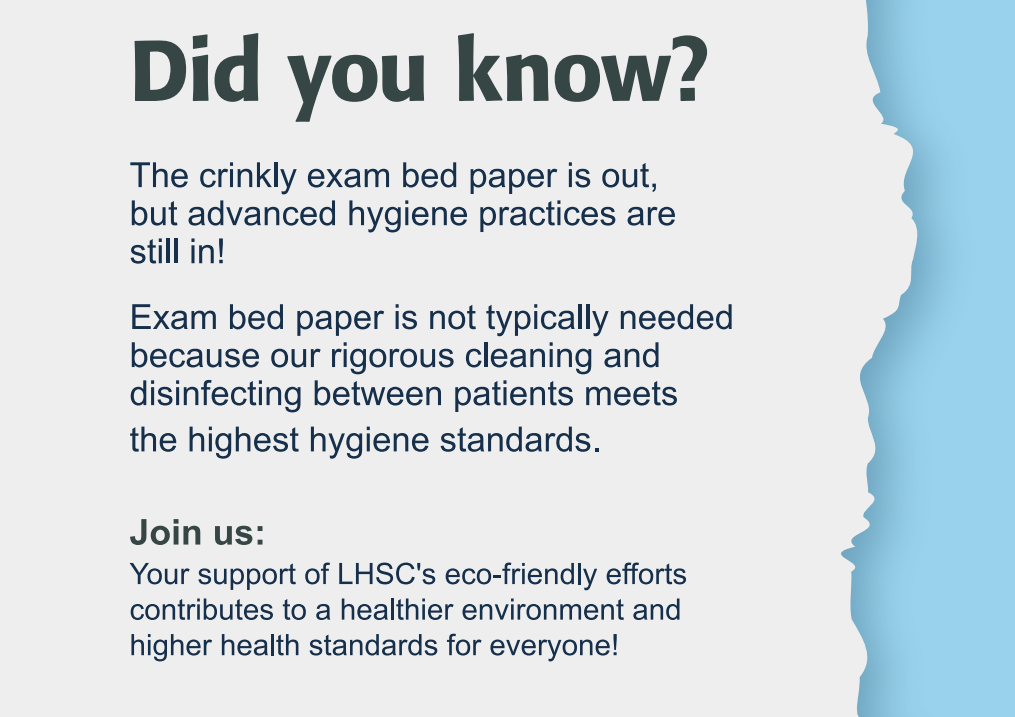
Exam Room Wall Poster
London Health Sciences Centre
An example of an exam room poster provided by London Health Sciences Centre on how exam bed paper does not reduce the spread of infections.
Poster