Toutes les ressources
La version française du site est en cours de révision et sera finalisée sous peu.
Exam Room Wall Poster (Option 2)
An example of an exam room poster provided by London Health Sciences Centre on how exam bed paper does not reduce the spread of infections.
Affiche

Go Green, Cut the Paper: Eliminating Exam Table Paper
A one-page summary explaining why exam table paper should be eliminated.
Document

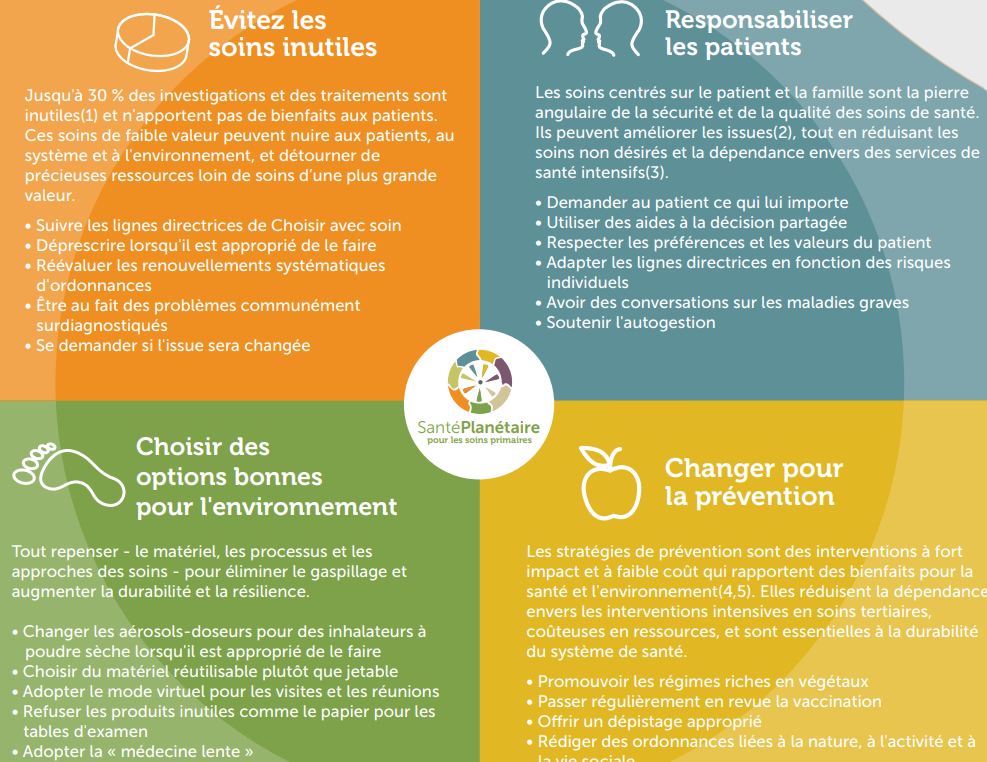
Four Principles of Environmentally Sustainable Clinical Care
An infographic for planetary health in primary care featuring four principles for environmentally sustainable healthcare: avoid unncessary care, empowering patients, choose environmental alternatives, shirt to prevention.
Infographie

Planetary Health for Primary Care
This primer is an introduction to planetary health in the primary care setting and is designed to highlight ways practitioners can integrate these principles into their clinical work. It is not intended to duplicate existing resources on other important topics such as political and personal actions or hospital-based solutions. It oers examples, practice tips and links to existing resources to educate, inspire and remove barriers to change, organized around the our principles. Readers may want to read it from start to finish or by sections.
Outil
Reducing healthcare waste by eliminating exam table paper in a primary care practice: a sustainable quality improvement initiative
This simple QI project demonstrates the feasibility of implementing a small change in a primary care clinic that can improve environmental sustainability with multiple co-benefits. If all family physicians in Canada eliminated exam table paper in their offices, it would result in savings of approximately 95 940 km of paper, 121 680 trees, $C8 400 600 and 3054 T CO2 emissions, equivalent to driving around the world 360 times.
Article
Planetary health lens for primary care: Considering environmental sustainability offers benefits to patients and to providers
Adopting a planetary health lens provides a new way to think about environmental sustainability in primary care. With many providers working together to incorporate the 4 principles of sustainable health care into our everyday work, we can help reduce the health sector’s environmental footprint with additional benefits for patients, providers, and the health care system.
Article

Reducing our Environmental Impact in Primary Care
This webinar features Ilona Hale, MD, exploring new ideas in environmentally sustainable clinical practice. It goes beyond basic measures like recycling and energy-efficient lighting, highlighting the connection between environmental sustainability and high-quality care, including patient-centred care, de-prescribing, and health promotion. The session explains how practicing high-quality, low-carbon care can improve patient outcomes, reduce healthcare system burden, decrease provider workload, and help address climate change. Ilona Hale is a family physician with the East Kootenay Division of Family Practice and an Assistant Clinical Professor in the Department of Family Practice at the University of British Columbia.
Webinaire

Pathway to Climate Resilience in Primary Health Care
This webinar presents a fireside chat hosted by CASCADES, the Indigenous Primary Health Care Council, and the Alliance for Healthier Communities. Panelists share insights on the role, responsibility, and capacity of the primary health care sector and health professionals in identifying and addressing climate change vulnerability and leading adaptation efforts. The discussion features Imara Rolston, Dakota Recollet, Selma Tobah, and Bev Taylor, and is moderated by Fiona Miller and Natasha Beaudin.
Webinaire

Environmental racism, justice, and impacts on the health of communities
This webinar is part of the “Climate, Health, and Healthcare” speaker series for health professional learners. It features Ingrid Waldron, MA, PhD, who discusses environmental racism, environmental justice, and their impacts on the health of communities.
Webinaire

Opportunities to address the environmental impacts of medication in primary care
This webinar examines how medications, while essential to healthcare, have significant environmental impacts and can contribute substantially to healthcare’s carbon footprint, particularly in primary care. It explains that most prescriptions are written in primary care, creating an opportunity for more sustainable prescribing practices that combine patient-centred care with reduced environmental impact. The session in the Sustainable Primary & Community Care Implementation Series features Ilona Hale, a family physician with the East Kootenay Division of Family Practice and Assistant Clinical Professor at the University of British Columbia, and Trudy Huyghebaert, a clinical pharmacist with the University of Calgary and Alberta Health Services, who share prescriber and pharmacist perspectives on sustainable medication use.
Webinaire