About the Sustainability-Embedded Quality Improvement Toolkit
This Toolkit is designed to stimulate environmental awareness and climate-conscious decision making.
This toolkit will help individuals and teams incorporate environmental sustainability into quality improvement (QI) initiatives, and envision how you can adjust, measure and report those impacts.
For new QI projects in formative stages, the Toolkit can help identify opportunities to enhance or avoid environmental impacts.
For more developed QI projects nearing final stages, the toolkit can help you showcase environmental co-benefits.
Why quality improvement as a vehicle for action?
Quality improvement is well positioned to deliver health system climate action for several reasons:
- QI provides a systematic approach and tools to organize point-of-care environmental sustainability efforts effectively and using recognized, validated strategies.
- QI offers spread infrastructure to facilitate the dissemination and scaling of successful improvements across different settings.
- QI interventions are informed by data and must include measurable change.
- QI can create clear linkages between sustainability and clinical care.
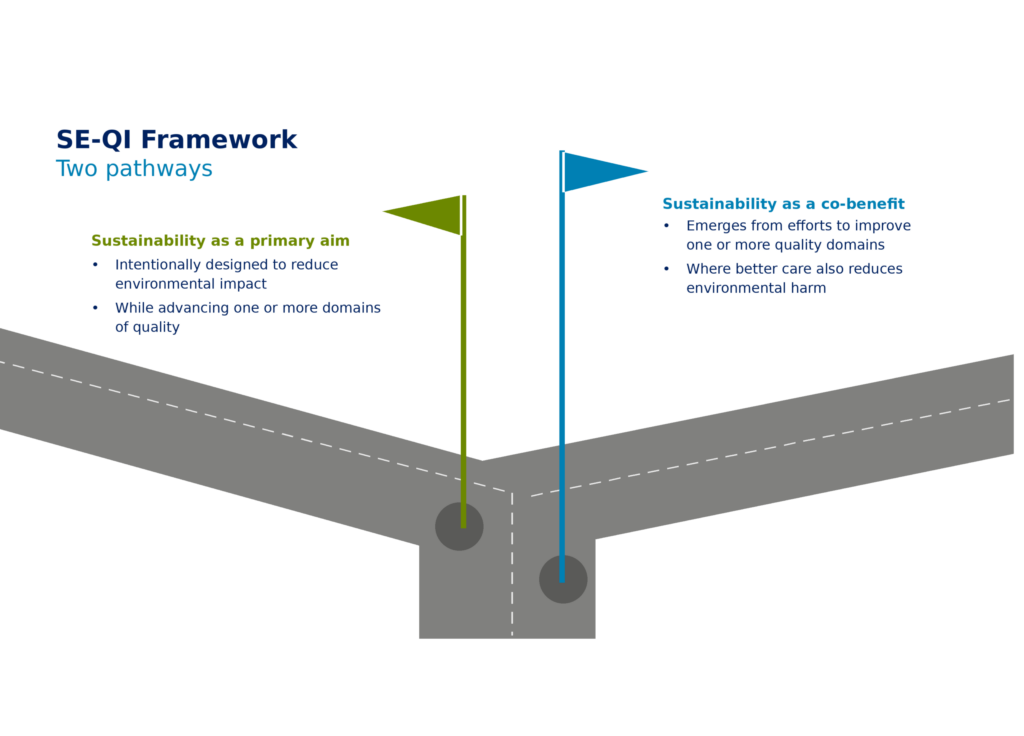
Within the SE-QI framework and toolkit, sustainability may be advanced through two complementary pathways. In many cases, sustainability emerges as a co-benefit of initiatives designed to improve safety, efficiency, or other dimensions of quality. In other cases, environmental sustainability is the primary focus of improvement work, with quality benefits emerging alongside it. Regardless of the approach, it is critical to clearly articulate how advancing sustainability efforts also contributes to other key dimensions of quality. For more information and support, please refer to the SE-QI Playbook (pages 15–17).
Toolkit Structure
It is recommended that you complete the subsequent Toolkit steps in order, however, you may choose to skip ahead.
Using the framework for sustainable health systems, developed by MacNeill, McGain, and Sherman (2021), you will be prompted to answer five questions about the aims of your project.
This step should be completed first in order to guide the development of more detailed project elements.
After having determined the relevant sustainable healthcare principles for your project, you will be asked a series of questions across 12 opportunity areas. These questions were developed to help you conceptualize the environmental impacts that your project might influence.
You will receive a report at the end of the module that details the environmental impacts deemed relevant, along with resources and potential metrics to guide you.
This step should be completed second, once you have a more thorough understanding of your project’s scope.
Using the information from your environmental impacts report, you will receive guidance on how to establish, collect, and compare activity data and environmental data. This can be used to track progress, share your project’s impact, and report on outcomes.
This step should be completed last in order to use the results from Steps 1 and 2.
Ready to start?
Working group members

Christine Henderson (Interior Health); Amanda Mckenzie (Interior Health); Ilona Hale (Interior Health); Andrea MacNeill (VCH/CASCADES); Arianna Cruz (VCH/CASCADES); Andrea Wnuk (Health Quality BC); Nicole Simms (CASCADES); Naba Khan (CASCADES)
Once you have completed the Toolkit, consider using the CASCADES Project Charter to help you organize your next steps.
SE-QI Spotlights